Monday, 10 March 2014

Welcome to the February blog.

The Weather as continued to have a massive impact on our work programme throughout February with ground conditions dictating the various work we have undertaken. The met office have produced data that confirms it has been the wettest winter on record. The table below shows our rainfall figures for the winter  period.
                                   
                                       December 2013        80 mm
                                        January    2014      144 mm
                                        February  2014        91 mm
                                         
                                                                      315 mm  Total
                                                                                               
Considering the above data we have managed to complete various work, the photographs below will show how we have progressed throughout the month.

Aeration to all parts of the course as been continuous this month. We used the services of John Mallinson to vertidrain our fairways. Mallinsons are a leading company in sports ground management and construction.
Aeration to the soil is a recognised technique for breaking up compaction, allowing better water peculation to the sub soils and drainage systems, it aids better rooting, and enables the exchange of oxygen and carbon dioxide in the soil structure.


Mallinsons heavy duty machinery allows us to use our soil reliever on greens and tees, it is hoped this practice will prolong the life of our machine. The picture below shows our soil reliever in action on the 18th green.


We regularly use the procore throughout winter relieving surface tension and allowing the turf to breath, this machine creates minimal surface disturbance.


After the various aeration machines have been used we follow up with the turf iron to settle and smooth out the surface.


Course Presentation

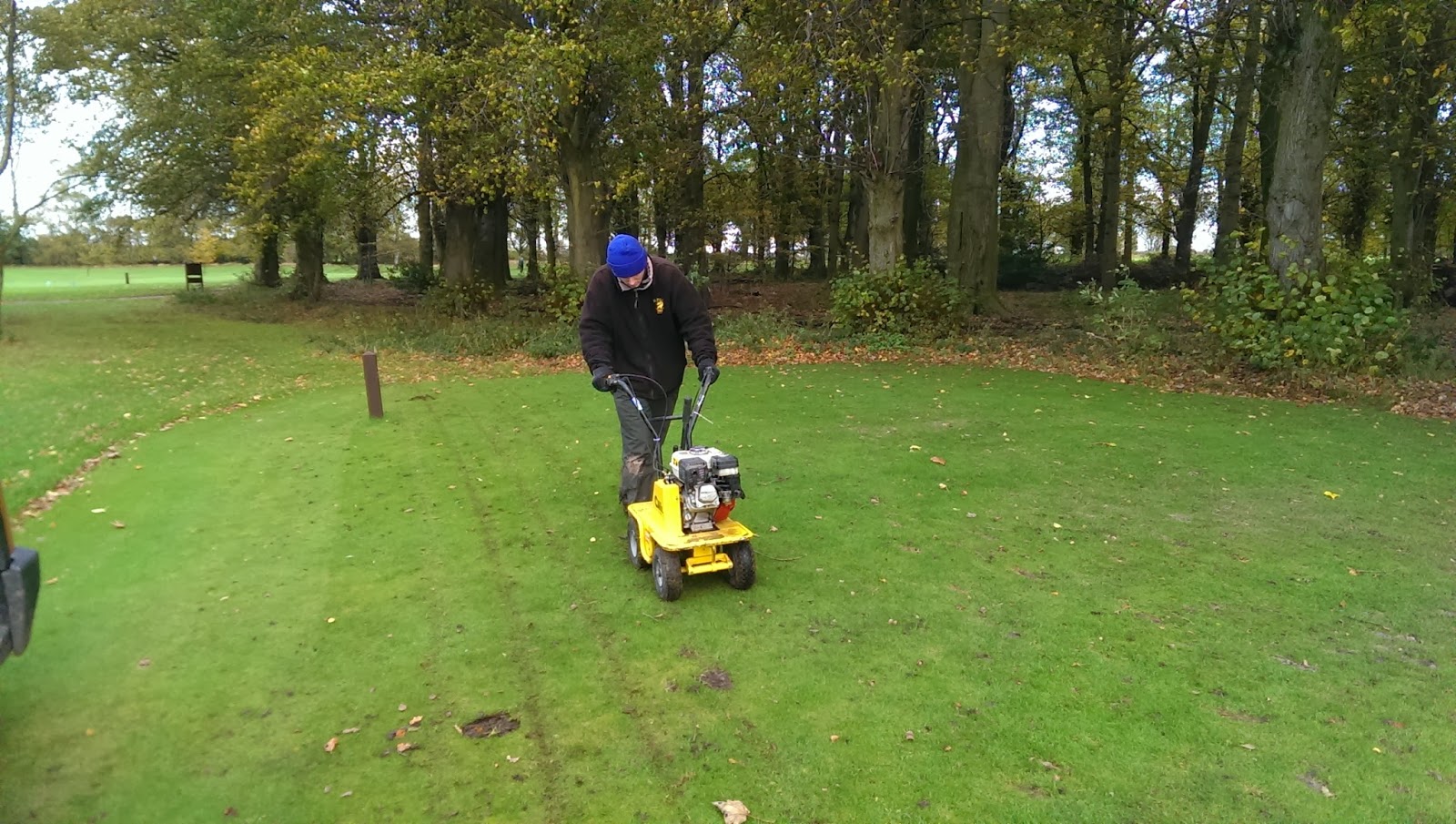
With the arrival of spring!!! we have started to edge up the paths and prepare them for resurfacing with shale.Whilst this is a time consuming job it improves the presentation of the course. As shown in the picture.


The path at the side of the 10th tee looking good.


Golf course ornithology


We really encourage wildlife on to the course it adds so much interest for the members and visitors as they play the course.In positioning bird boxes we feel we are contributing in creating additional habitats in a landscape that offers great nesting opportunities.


It's that time of the year again, when the bird boxes get cleaned out ready for their new inhabitants , Daniel Gildea is cleaning out the box, Chris Lewis is footing the ladder.


Special thanks to Mr Derek Walkden, Mr Brian Wakefield and Mr Stephen Reynolds who have generously supplied additional bird boxes this year.

I conclude in the hope that my next blog will inform you that we have commenced;  top dressing greens and  tees, applying fertiliser and wetting agents and yes you've guessed it continuing aeration work........this is of course, all dependent on the weather!!!!                                                              
                                                                                   Terry Wharton    Head Greenkeeper


Friday, 31 January 2014

Welcome to the January Blog. 

The weather throughout January has made managing the golf course difficult, but spare a thought for the people around the country who have seen utter devastation to their homes and work places.

 January 2013 seen rainfall figures of 65mm against January 2014 of 144mm yet even with such excessive rainfall over the past month the greens team have managed to complete regular work programmes to the greens, they have been  slit tined and procored, rolled and have received applications of soluble iron  to harden the turf and aid presentation.


     The photographs below show additional work the team have completed throughout January.

                               
The 13th bunker with a mat positioned in the base and on the face to reduce any stones from becoming loose and affecting its playing quality. It also reduces soil erosion from the face which over time changes the characteristics of the sands playability and drainage qualities.


The completed bunker, it feels like this bunker took a while to finish, but due to the large amount of soil movement and shaping it had to be worked when the soil was dry. It would be foolish to have attempted  the shaping in really wet conditions only to break down the structure of the soil and make it difficult to dry out.


Bunker Drainage
                       We redrained the two greenside bunkers at the 17th  recently.


                    This picture shows the joint from the drain connected to the main outlet


               The drainage pipe positioned in the bunker ready to be covered with 2-6mm grit.


         Drainage stone being levelled above the pipe in the trench ready for rootzone and turfing


                                                         Completed bunker.

In February we hope to start a programme of vertidraining / slitting  the greens, tees and fairways.Edging up paths and re stoning them is another job we aim to tackle, it could be a busy time if the weather is kind.


                                                                            Terry Wharton  Head Greenkeeper

Tuesday, 14 January 2014

Welcome to our December update,  i hope all the readers of the blog have a happy and peaceful new year.

It also gives me the opportunity to thank the greenkeeping team at Haydock Park for all their commitment and passion throughout the year in maintaining the course to such a good standard.   


       In December we managed to complete the levelling and returfing of the 18th/12th/14th and 8th tees. 


                                            The turf used is LT 4 supplied by All turf.  


Bunker Maintenance

Work as started on the 13th cross bunker, the team have re shaped it and put in a new drain, this will be followed up with a bunker mat positioned in the base to reduce sand discolouration, stone movement  and the sand being washed down from the face in heavy rainfall.

The bunker work is a part of our winter programme to maintain and reshape them with our aim to achieve better playing qualities and visual appeal.


Raking bunkers 

Below is a picture showing the wear of the teeth on a rake less than 12 months old, compared to a new rake. The seventy six bunkers on the course keep us busy and its now obvious they also wear the rakes out.


The January blog will show work on the drainage of the 17th green side bunkers and the finished bunker at the 13th hole.

                                                                                 Terry Wharton      Head Greenkeeper

Sunday, 1 December 2013

November update.

Welcome to our November blog, the weather has enabled us to complete  the positioning of our winter tee mats on the 2nd 4th 8th 13th and 18th holes and put in additional paths to ease wear and tear around them.

Our programme of levelling the 8th 12th 14th and 18th tees is moving along well and we hope to see them turfed very soon. Below are some pictures showing our progress on the 18th tee, and additional work.


The picture above shows Chris Lewis using the turf cutter to lift the turf. 


  The turf is stripped off, unfortunately because of its high sand content in the upper profile it is difficult to lift and put back down.We will be re turfing with a turf containing fescue and smooth stalk meadow grass species.These grasses are hard wearing and offer great presentation when the turf is mown.             


                       New levels are positioned on the tee, which are the white dots in the picture, the tee is firmed and raked numerous times to achieve the correct surface levels.


Throughout the past month the greens team have been busy removing the leaves off the course with hand blowers and the tractor mounted blower. The picture above shows the leaves from the 11th fairway being blown in to the colonels wood.


We recently purchased a power brush to keep the mats clean and to aid in their presentation. 
The winter tee mat at the 14th is being cleaned with the power brush.The brush does a great job in removing debris from the pile of the mat and is used regularly  


The picture above shows the toadstool Fly Agaric which as been growing  in many areas around the course.It was traditionally used as a insecticide,the toxic toadstool contains ibotenic acid which attracts and kills flies. And in Victorian and Edwardian  times it was commonly found on Christmas cards as a sign of good luck, its colours may have been the inspiration for Santa's red and white suit.


In the December blog i hope to show you our work on the cross bunker on the 13th hole, the completed tees, and the drainage of the greenside bunkers at the 17th green.

                                                      Terry Wharton    Head Greenkeeper

Wednesday, 30 October 2013

October up-date. 

Welcome to our October blog, the month has flew by and autumn has crept up on us, the mild temperatures have enabled growth to continue on most areas of the course.

The recent wet and mild conditions make it favourable for disease to take hold on the greens ,we make every effort to avoid it through correct cultural practices and chemical control.

 However when the disease pressure is high it is difficult to contain. The main turf disease is Fusarium which is a fungus that can kill and damage the leaf blade and crown of the grass plant.

 Winter Programme.

 We have started to position winter tee mats on various holes on the course the photographs will show the work involved in constructing them. The pictures below show the new mat on the 18th tee


                                           The picture shows the positioning of the mat
The timbers are positioned and levelled to create the frame.


Batons are nailed around the timbers to secure the mat and stone is firmed and topped off with sand. 


The mat is nailed in to the batons

The area around the mat is raked and seeded.


We cut out a new path to create various routes from the mat to try to reduce wear. 


In the November blog we will look at the tees that are being levelled and re-turfed. 

                           
                                                                     Terry Wharton        Head Greenkeeper

Monday, 16 September 2013

Welcome to our September blog.

The recent weather has been kind to us and it's enabled us to carry out deep aeration, top dressing and over seeding work on the greens and tees.

With the soil structure firm and dry it's been ideal to carry out this work. The tines have been set to around 300mm and at this depth they will brake up surface tension and any lower profile compaction.

This work will help to develop stronger root systems and allow a greater exchange of oxygen and carbon dioxide in the soil structure.

Over the past few years the ground conditions haven't been ideal for this practice due to the large amounts of rainfall.

                                              The picture shows the machine in action

After the deep aeration the surfaces were top dressed and brushed, this was then followed up with rolling to smooth them out.

The height of cut was slightly raised and we allowed the greens to settle for two weeks.We then solid tined with 8mm tines fitted to the procore, they were then top dressed, bringing our total applications too 100 tonnes this year.

 With the top dressing on the surface we over seeded with various cultivars of browntop bent , this was brushed in,and followed with a light covering of water from the irrigation system to help wash the seed in to the tine holes.

It is hoped  the seed will germinate in around 14 days, the timing of this work is important because with good temperatures and growing condition's any surface disturbance will soon settle down giving good playing conditions going in to autumn.


The pictures below show the bottom of the hole cutter that we use to change the holes on the greens, it shows the length of the new root's after the aeration programme they measure at around 250mm.


It is very pleasing to see the development of the healthy roots.

The rooting channels will aid drainage, they also show how the profile has been opened up to enable the root system to develop.

Surface water can access these channels and speed up the peculation through the soil structure.

Regular aeration work is so important in managing fine turf.

We allow the seed to develop over the next few weeks and then start our winter programme of slitting and solid tining on a regular basis depending on the weather conditions.


Preparing the mounds for autumn / winter.

This week we started cutting back the mounds between the 13th and 15th fairways, over the next couple of weeks we aim to complete the work on all the mounds situated around the course.

We cut the mounds short to weaken the course grasses,all the cut grass is raked up and removed  to reduce any available nutrients to be taken up from it.

 It is well acknowledged that the finer grasses thrive on minimal soil nutrients and in managing the mounds in this way we aim  to develop the finer wispy grasses. This practice will  make the mounds penal, yet enable the golfers to find their balls.


The picture below shows one of the completed mounds, these are cut yearly, we are seeing a significant change in grass composition from the course grass to the favourable fine species.


New path from the 16th tee to the 18th tee

We recently took advantage of the dry weather and cut and shaped the path.It is hoped this surface will allow our members and visitors to access the tees with a scenic walk on the edge of the colonels wood.


The various stages of the work are shown.

The side photo shows the basic shape marked out.

We aim to create smooth curves that blend in to the landscape and avoid straight lines.


The digger cutting out the path.

The soil was placed either side and  raked out.
When the shape was completed, stone was added to a depth of 100 mm raked  and consolidated.


The finished path.

Over the next couple of weeks we will plant daffodil bulbs along the side of the path, these will enhance the blue bells that flower regularly in spring.


As you can see our work load has been varied and busy over the past month along side course preparation.

The greens team have worked well in completing this work with minimal disturbance to our members and visitors.

Our October blog will be highlighting some of the projects we will be working on in our winter programme.


Terry Wharton   Head Greenkeeper.  


Monday, 12 August 2013

August Update.

Welcome to our August blog, the greens team have been really busy preparing the course in some glorious weather.

However what a difference we've seen over the past seven months , below are the monthly rainfall figures from 2012/2013
January through to July shows the huge differences in some of the monthly amounts.

The picture below seems a distant memory, the team were squeegeeing water from around various parts of the course last July.


      2012                           2013

     January    100mm         65mm
     February    39mm         62mm
     March        23mm         69mm
     April        107mm         14mm
      May          76mm         59mm
     June         148mm        45mm
     July          131mm        46mm

       Total =  624mm        360mm


12th Green Root Structure.

Our policy of controlled irrigation  throughout the recent warm dry weather enabled the root system on the newly turfed area on the 12th green to develop.

The pictures below shows a core that as been removed showing how the roots have grown stronger and deeper, if the root zone had received excessive irrigation the root structure would be weak and shallow.

The plant as sent out  roots  to develop and penetrate the soil structure. Look how the root system is developing in the sand particles on the bottom picture.                                                                                                                    


Bunker Management 

The picture below shows Jack Hosker tilling up bunkers, this practice reduces panning, the tiller brakes up the sand to a depth of around  one hundred millimetres.

When the bunkers are loosened up it allows the sand to be raked evenly giving a consistent depth.


Machinery Maintenance   

We have a policy to regularly check all the machinery for basic maintenance work, the machine below is the Toro 4000 rough cutter.

 When a machine goes out on to the course a chart is filled in by the operator to show they have checked all the various levels ie water fuel,hydraulic oil, tyre pressures etc.

 The picture shows the front covers being removed from the cutting unit  to check belt tension and to apply grease.


Next months blog will cover our aeration work and over seeding of the greens, it will be the start of a busy period when we  prepare the course for the start of autumn.


Terry Wharton                  Head Greenkeeper