Monday, 16 September 2013

Welcome to our September blog.

The recent weather has been kind to us and it's enabled us to carry out deep aeration, top dressing and over seeding work on the greens and tees.

With the soil structure firm and dry it's been ideal to carry out this work. The tines have been set to around 300mm and at this depth they will brake up surface tension and any lower profile compaction.

This work will help to develop stronger root systems and allow a greater exchange of oxygen and carbon dioxide in the soil structure.

Over the past few years the ground conditions haven't been ideal for this practice due to the large amounts of rainfall.

                                              The picture shows the machine in action

After the deep aeration the surfaces were top dressed and brushed, this was then followed up with rolling to smooth them out.

The height of cut was slightly raised and we allowed the greens to settle for two weeks.We then solid tined with 8mm tines fitted to the procore, they were then top dressed, bringing our total applications too 100 tonnes this year.

 With the top dressing on the surface we over seeded with various cultivars of browntop bent , this was brushed in,and followed with a light covering of water from the irrigation system to help wash the seed in to the tine holes.

It is hoped  the seed will germinate in around 14 days, the timing of this work is important because with good temperatures and growing condition's any surface disturbance will soon settle down giving good playing conditions going in to autumn.


The pictures below show the bottom of the hole cutter that we use to change the holes on the greens, it shows the length of the new root's after the aeration programme they measure at around 250mm.


It is very pleasing to see the development of the healthy roots.

The rooting channels will aid drainage, they also show how the profile has been opened up to enable the root system to develop.

Surface water can access these channels and speed up the peculation through the soil structure.

Regular aeration work is so important in managing fine turf.

We allow the seed to develop over the next few weeks and then start our winter programme of slitting and solid tining on a regular basis depending on the weather conditions.


Preparing the mounds for autumn / winter.

This week we started cutting back the mounds between the 13th and 15th fairways, over the next couple of weeks we aim to complete the work on all the mounds situated around the course.

We cut the mounds short to weaken the course grasses,all the cut grass is raked up and removed  to reduce any available nutrients to be taken up from it.

 It is well acknowledged that the finer grasses thrive on minimal soil nutrients and in managing the mounds in this way we aim  to develop the finer wispy grasses. This practice will  make the mounds penal, yet enable the golfers to find their balls.


The picture below shows one of the completed mounds, these are cut yearly, we are seeing a significant change in grass composition from the course grass to the favourable fine species.


New path from the 16th tee to the 18th tee

We recently took advantage of the dry weather and cut and shaped the path.It is hoped this surface will allow our members and visitors to access the tees with a scenic walk on the edge of the colonels wood.


The various stages of the work are shown.

The side photo shows the basic shape marked out.

We aim to create smooth curves that blend in to the landscape and avoid straight lines.


The digger cutting out the path.

The soil was placed either side and  raked out.
When the shape was completed, stone was added to a depth of 100 mm raked  and consolidated.


The finished path.

Over the next couple of weeks we will plant daffodil bulbs along the side of the path, these will enhance the blue bells that flower regularly in spring.


As you can see our work load has been varied and busy over the past month along side course preparation.

The greens team have worked well in completing this work with minimal disturbance to our members and visitors.

Our October blog will be highlighting some of the projects we will be working on in our winter programme.


Terry Wharton   Head Greenkeeper.  


Monday, 12 August 2013

August Update.

Welcome to our August blog, the greens team have been really busy preparing the course in some glorious weather.

However what a difference we've seen over the past seven months , below are the monthly rainfall figures from 2012/2013
January through to July shows the huge differences in some of the monthly amounts.

The picture below seems a distant memory, the team were squeegeeing water from around various parts of the course last July.


      2012                           2013

     January    100mm         65mm
     February    39mm         62mm
     March        23mm         69mm
     April        107mm         14mm
      May          76mm         59mm
     June         148mm        45mm
     July          131mm        46mm

       Total =  624mm        360mm


12th Green Root Structure.

Our policy of controlled irrigation  throughout the recent warm dry weather enabled the root system on the newly turfed area on the 12th green to develop.

The pictures below shows a core that as been removed showing how the roots have grown stronger and deeper, if the root zone had received excessive irrigation the root structure would be weak and shallow.

The plant as sent out  roots  to develop and penetrate the soil structure. Look how the root system is developing in the sand particles on the bottom picture.                                                                                                                    


Bunker Management 

The picture below shows Jack Hosker tilling up bunkers, this practice reduces panning, the tiller brakes up the sand to a depth of around  one hundred millimetres.

When the bunkers are loosened up it allows the sand to be raked evenly giving a consistent depth.


Machinery Maintenance   

We have a policy to regularly check all the machinery for basic maintenance work, the machine below is the Toro 4000 rough cutter.

 When a machine goes out on to the course a chart is filled in by the operator to show they have checked all the various levels ie water fuel,hydraulic oil, tyre pressures etc.

 The picture shows the front covers being removed from the cutting unit  to check belt tension and to apply grease.


Next months blog will cover our aeration work and over seeding of the greens, it will be the start of a busy period when we  prepare the course for the start of autumn.


Terry Wharton                  Head Greenkeeper  


Wednesday, 10 July 2013

Course update.

Hello and welcome to our July blog.

We've had a great period of  warm weather over the past month, this has enabled us to prepare the course to a good standard.

Agronomy Visit.
In June we had our annual visit from Alistair Beggs who is head of Agronomy and Ecology at the STRI   (Sports Turf Research Institute)

 Alistair is an official R&A agronomist and advices many open championship venues.He has been visiting us for 14 years and provides valuable knowledge and advice on analysing the performance and condition of the course.                                                                          
During the visit the speed,smoothness/trueness and firmness are measured on selected greens.

Additional testing is also carried out to determine the moisture content,organic matter content and chemical analysis of the upper profile of the greens.

 Target performance levels are set with the aim to produce greens that provide smooth/true and well paced surfaces. A report giving the results and data of the visit can be found on the clubs notice board.                                                    

The picture above shows Alistair Beggs measuring the trueness and smoothness with the trueness meter the device measures smoothness (vertical deviation) and trueness (lateral deviation) of the putting surfaces.  


       The picture above shows David Traynor measuring the surface firmness of the greens using the Clegg Impact Hammer. Nine readings are taken in a sampling grid to calculate an average reading of the greens.                                                                                           


The Stimpmeter is being used in this picture to find the speed at which the ball rolls.Three balls are rolled down the stimpmeter and repeated in the opposite direction.

Readings are taken of the two distances the balls travelled,the further the ball travels the faster the surface is.


  The soil moisture content is measured by using a Theta Probe Moisture Meter as shown in the above picture.Nine readings are taken on each green and the average is calculated.

It is important that moisture content is monitored, if its too high the turf will become soft and the condition of the turf will suffer.However if its too low the consistency and uniformity of the turf can become compromised. We aim to keep our moisture content in the range of 15-30%.  

The blog in August will cover machinery and bunker maintenance.

Terry Wharton    Head Greenkeeper   July 2013

Monday, 10 June 2013

Latest Course Information

Welcome to our June blog it was recently confirmed that spring was the coldest for fifty years, however we've seen the temperature gauge moving in the right direction.

 The greens team have been extremely busy preparing the course with significant growth, allowing cutting and shaping on all areas of the course.

Greens Machine And Front Mounted Brush

The pictures below show Daniel Gildea cutting the greens,the machine is a Toro 3250, positioned at the front of the mower is a mounted brush, this follows the contours on the greens allowing the grass to be brushed up enabling a quality cut to be achieved.


The close up picture shows the bristles hugging the turf and lifting up lateral growth.


The picture on the left shows one of the units from our greens machines In the middle of the unit is a setting bar.

The bar allows accurate heights of cut to be achieved.
The unit on the right is a grooming unit, this works alongside the front mounted brush lifting lateral growth.It can be set to various depths,depending on turf quality, and the turf management programme.

The three grooming units are interchangeable with the cutting units on the greens machines.  


Irrigation

The Irrigation system has been checked over recently, this enables prudent water applications to be delivered to the turf areas on greens and tees.

Controlled irrigation will enable firm surfaces to be achieved that offer desirable grass species to be developed in the sward.


The storage tank holds 72,000 litres of water,that are abstracted from a bore hole.

A licence is needed to abstract the water and records are kept of the amounts used.

Stringent measures are used by the Environment Agency to deter excessive use.

The Royal & Ancient Golf Society suggest, 

"The development and maintenance of quality playing surfaces is, essentially, all about water management.
If the greenkeeper gets water management right then the golf course will be sustainable in all regards"


Wild Flowers


The wild flowers at the side of the second tee are showing some beautiful colours.

Early spring showed a colourful collection of daffodils.


As the daffs faded, Oxeye Daisey Feverfew, Red campion, and creeping buttercup have grown in the border, giving a great display.

It is hoped that this area will become environmentally beneficial encouraging, bees, butterflies, and other insects and wildlife to prosper.
Augusta Behind the Scenes


The information below has been taken from the Grange over Sands Golf Club blog. Special thanks to Rob Sandilands, head greenkeeper, for allowing me to reprint this article.  http://gosgcgreenkeeping.blogspot.co.uk

Here are some great behind the scenes photographs showing not only what goes into making Augusta and The Masters such a spectacle, but also how far apart it is in so many ways from member's clubs like ours where most of us play our golf.  
Special thanks to Chris Lomas, club manager at  http://www.worplesdongc.co.uk/ for the pictures.

For the time outside of the tournament, the course is closed from May-October.  During normal times of opening each hole has 2 full-time greenkeepers, this swells by over 100 for the tournament.  The course even has its own Creek Manager for it's famed water features!
The picture below shows the greenkeeping facility; a building that has 2 full time receptionists as well as a trial green and bunker for products and testing 


 Those 100 greenkeepers need a big room for team briefings as well as lots of tea and coffee!


 Below is the chemical store, putting into perspective just what it takes to achieve what is presented out on the course.
 Many of you may think the pine straw beneath the trees is all naturally occurring on the site, but in fact hundreds of bales of it are imported and spread out on the course.  Below is there dedicated storage area.

Many parts of the course are given a helping hand with systems such as the 'sub-air' which is capable not only of drawing water down through the surfaces but also blowing air back into them. Not only is this system installed on the greens, but also on the grass walkways so as to keep the patrons feet dry!  This system costs over £1 million.  Below is another tool used to help growth and condition; these lighting rigs give grass an added boost when sunlight is at a premium.  You may have seen them in action at football grounds in the English Premier League over the last couple of years.


Nurseries serving the site have a replica tree and shrub for each one out on the course that is covered on TV and feasible to replace; monitoring their health as well as that of the hallowed turf requires a dedicated on site turf laboratory, pictured below.


Out on the course, you may well have seen the famous shots of the 15 or so fairway mowers all cutting in formation going from green to tee to make the ball roll 'into the grain' and slow it down, although each on of these machines cost £45,000 breakdowns do happen and the picture below shows how a tennis ball is carried by each operator to throw into the path of the operator in front of them in the line if they develop an oil leak.  A great idea that is used in all major tournaments and one that I have used myself while working at the Scottish Open at Castle Stuart in 2011.


I'm sure you'll agree that it is an impressive amount of resources and a real eye-opener.  The most important thing for us all to remember is that these things are all relative and each club has their own individual level of resources which they must use in a sustainable way that ensure they live within their means, whilst also being mindful of their role in the landscape and their responsibilities to the environment.  Here is a link that sums up the reccomended approach to golf course management in the UK:
The R & A - Sustainable Golf

 Many thanks to Rob and Chris for such an interesting article.

                                                                         Terry Wharton   Head Greenkeeper        June   2013

Monday, 6 May 2013

Latest blog


Welcome to our May blog,in the earlier blogs we were asking for a period of dry weather,well we've certainly had it with minimal rainfall throughout April.

As greenkeepers we need a balanced programme of weather conditions, yet we seem to move from one extreme to another.This recent dry cool spell as held back growth on the course with the greens needing the    areas of annual meadow grass to catch up to the larger areas of bent grass.The bents grow in lower temperatures than the annual meadow grass and this causes slight unevenness on the greens surfaces.


The picture shows the desirable bent grass on the greens with its broad leaf colonising the sward, the thinner leafed annual meadow grass is also visible.

 We continue to change the composition of the grass species on the the greens to the bent grass because of the following reasons, it is hard wearing, good drought qualities, less prone to disease, enables all year round play, against the annual meadow grass that doesn't have the same characteristics of the bent grass


With better growing conditions sensible cutting heights,grooming, minimal feed, and regular top dressings the surface levels will soon become smoother and better ball roll will be achieved.


The recent rise in soil temperature allowed us to feed the greens the picture shows Chris Lewis feeding the 11th green.Chris is still wearing his winter clothes in early April, roll on summer!!!!


 We apply a low Nitrogen feed that aims to create minimal healthy growth,yet enables the plant to develop a strong root structure.The bent grass will grow well with controlled feeds alongside regular aeration top dressings and applications of seaweed.


This picture shows a new tine on the left and a worn tine on the right that are fitted to the procore aeration machine. The tine on the right has been used three times on the greens and once on the tees and surrounds.
The heavy sand profile in the root zone creates the wear.


Its a busy time for our sprayer through out the growing season with regular applications of wetting agents, turf conditioners,and soluble iron being sprayed on to the greens.


We recently used a wacker plate in the 16th fairway bunkers, the plate is used in construction and building to consolidate surfaces,We used it firm the sand and reduce balls from plugging.

Deputy Head Greenkeeper Dave Traynor can be seen operating the plate.


We came in to work on the 18th April and where surprised to see that a large oak tree had blown down in the colonels wood, unfortunately as it fell it brought down two smaller trees. These will be cleaned up and in the autumn new trees will be planted in their places.


It must be spring, the picture shows a mass of frog spawn in the pond near the 8th green.We hope they can develop before the ducks and herons decide to investigate them. When your near the pond over the next few weeks keep a look out for our new additions to pond life.

Our blog in June will cover wetting agents, top dressing, and the irrigation system.  

                                                                   Terry Wharton   Head Greenkeeper  May  2013


Monday, 8 April 2013

April update


Welcome to our April blog

The prolonged period of cold weather has held back our programme of feeding the greens, tees and surrounds. The low soil temperatures restricts the fertiliser from being taken up by the roots of the grass plant, a minimum soil temperature of around 10 degrees Celsius is needed to aid the up take of the nutrients.

We recorded soil temperatures of between 2-5 degrees Celsius over the past month which confirmed our reluctance to feed. It is hoped  the weather system will soon allow temperatures to rise and bring spring like conditions, enabling us to carry out the applications.

Scarifying Fairways

Even though our fertiliser programme was interrupted by the dry cold weather it allowed us to scarify the fairways and practice ground.This picture shows greenkeeper Ken Bennison using our Kioti DK 501 tractor with the Wessex proline scarifier.

The scarifier slices through the turf sward  removing any build  up of fibre at the base of the plant.If the fibre is allowed to build up it would create a spongy surface that would retain moisture weeds and moss.

This practice works alongside vertidraining and slitting with the objective of maintaining a firm turf surface that creates a healthy deep rooting plant growing in desirable soil conditions.


Ornithology Programme

The parkland setting of the course offers a haven for wildlife with woodland in and around the boundary,specimen mature oak, beech, ash, lime and silver birch trees are positioned around the course.

These trees create great environmental habitats and this is aided by our team putting up bird boxes and cleaning out last years used boxes.Jack Hosker and Chris Lewis can be seen cleaning out the box behind the 6th green.

  Birds that have been spotted  around the course include, the green woodpecker, kingfishers, hen harrier, siskin, reed bunting, and  spotted flycatcher's

 Hopefully the bird population can be increased in the colonels wood which has recently seen ten new bird and bat boxes positioned, special thanks to Messrs Arthur Richardson and Stan Wilcock for making and supplying the boxes.


Greens Aeration   (Procore)


Jack Hosker can be seen using the procore on the greens, this machine enables aeration at various depths to take place with minimal surface disturbance. It reduce's surface tension and allows applications of fertiliser, top dressings and wetting agents to target the rootzone.


The procore uses various tines and sizes, it is used on a regular programme on greens, tees and surronds to reduce compaction and to promote healthy root structures.


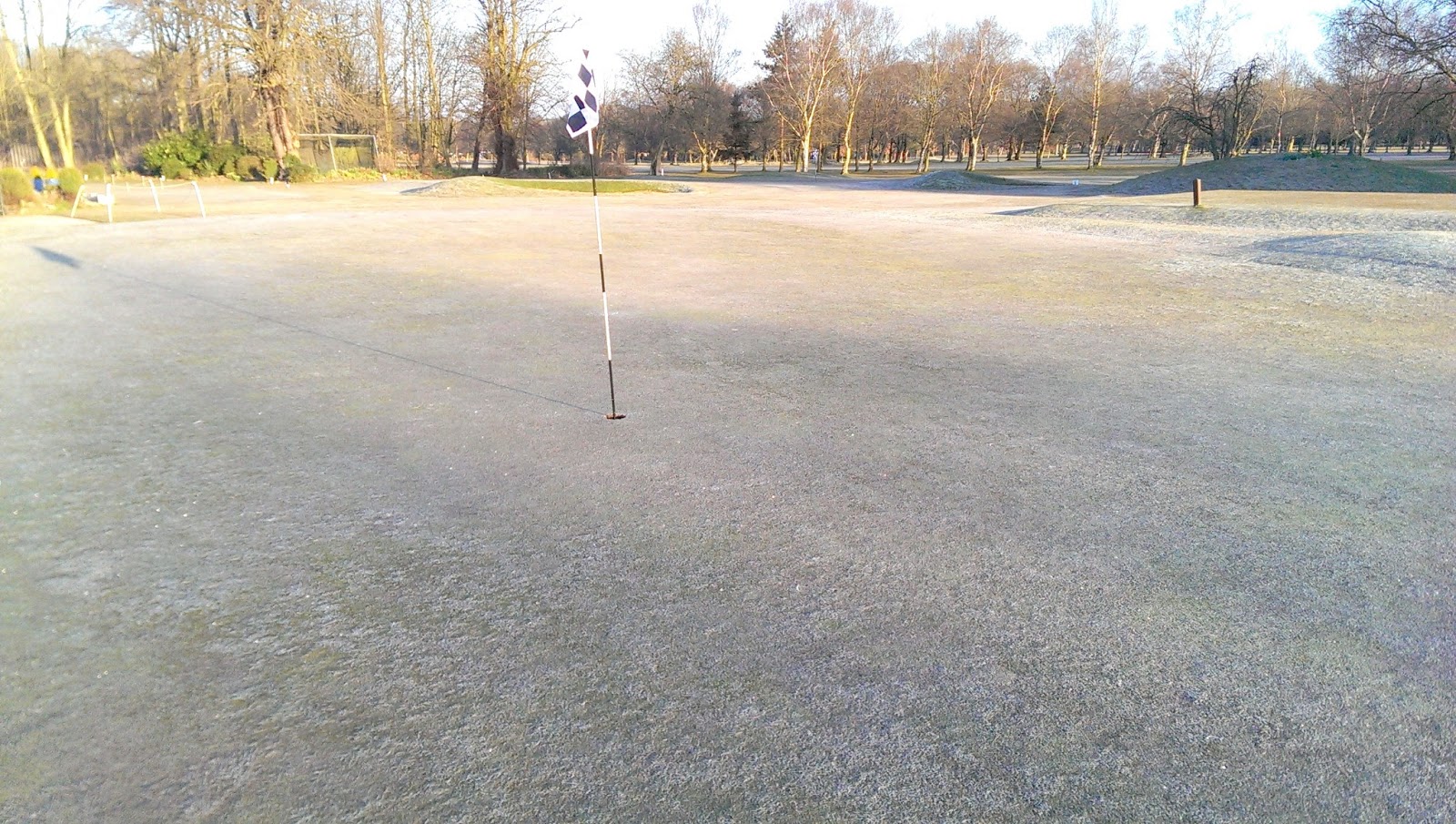
Why we stay off frosty greens

Many golfers ask the question.      "what damage does the frost do to the greens"?

 When moisture in and around the the leaf blade freezes,it makes the leaf  brittle, when foot traffic walks on to the frozen plants it breaks the leaf and causes them to die.

 It is well recognised that in periods of deep frost that's penetrated the rootzone, damage will be caused to the roots when thawing takes place if walked on.

This happens when the upper profile thaws and the lower profile could still be frozen, foot traffic on the turf in these conditions will create shearing and breaking of the root system.Over a short period of time the turf would die back creating uneven surface levels.

We aim to keep the flags on the greens at all times, unfortunately in frosty conditions we have to use the temporary greens because of the above reasons.


Our blog in May will cover the various techniques used in preparing the course. It will also show and explain some of the cutting machines we use, and hopefully discuss our spring feeding programme.


Terry Wharton    Head Greenkeeper    April    2013


Tuesday, 12 March 2013

March Update

Welcome to our March blog, the period of recent dry weather enabled us to cut the greens, tees, and fairways it  allowed us to complete the shaping and turfing of the bunkers on the 16th hole. We also managed to scarify the fairways and practice area.

The greens received a spray of soluble Iron (Fe) and were pro-cored with 8mm solid tines, this work was followed up with a light top dressing and rolling.


The pictures below show the various stages of work on the 16th hole fairway bunkers.


The picture shows the shaping of the banks and positioning of a new drain through the middle of one of  the bunkers.

When the shaping is completed the banks are firmed and raked to prepare them for turfing .


Greenkeepers Jack Hosker and Chris Lewis did a great job in getting the bunkers ready for turfing.


The turf we use on the faces of the bunkers is a hard wearing type called Rhizomatous Tall Fescue.


 This turf is ideal for bunker work because of its ability to develop deep roots.We feel that it offers great visual characteristics through its dense leaf blade and colour.


When the shaping and turfing is complete we add the sand and allow it to settle.


To obtain better firmness in the base of the bunkers a wacker plate will be used. It is hoped that this will reduce any balls from plugging.


We will put the bunkers under Ground Under Repair until  the turf is fully rooted and stable.


                                   Aeration work


 Aeration of the greens, tees, surrounds and fairways have taken place regularly throughout the winter period.

It is critical that the soil structure is regularly aerated to reduce compaction, thatch build up, and to help develop a healthy root system, this practice also allows the movement of water through the soil profile to access the drainage systems.


 The picture shows our soil reliever aerating the greens at a depth of 300 mm   


                          Tree Management


Throughout the winter period the green staff have crown lifted and thinned out trees that have been diseased or damaged, also trees that have grown too close together restricting their growth and shape


It  will allow healthier species of trees to develop, enable better air flow and sun light penetration and will create firmer, drier ground conditions


This  shows the decay inside the cavity of a silver birch, notice the minimal healthy wood around its edge


From a distance this tree looked reasonably solid, it was only after a  visual inspection that characteristic fungi and disease was noticed showing the signs of decay.


At the time of writing this blog we are experiencing an unseasonable cold spell with minimal growth, lets hope that spring is not too  far away.

 In my next blog in April I will hope to tell you about our busy programme of top dressing the greens,and tees, applying wetting agents, fertiliser applications,scarifying fairways and our ornithology programme.


Terry Wharton       Head Greenkeeper     12  March   2013